Hiring · Design leadership
Fractional design lead vs freelancer vs full-time hire
Three ways to bring design into your team, and how to choose between them: what each one owns, what it costs and when it’s the right fit.
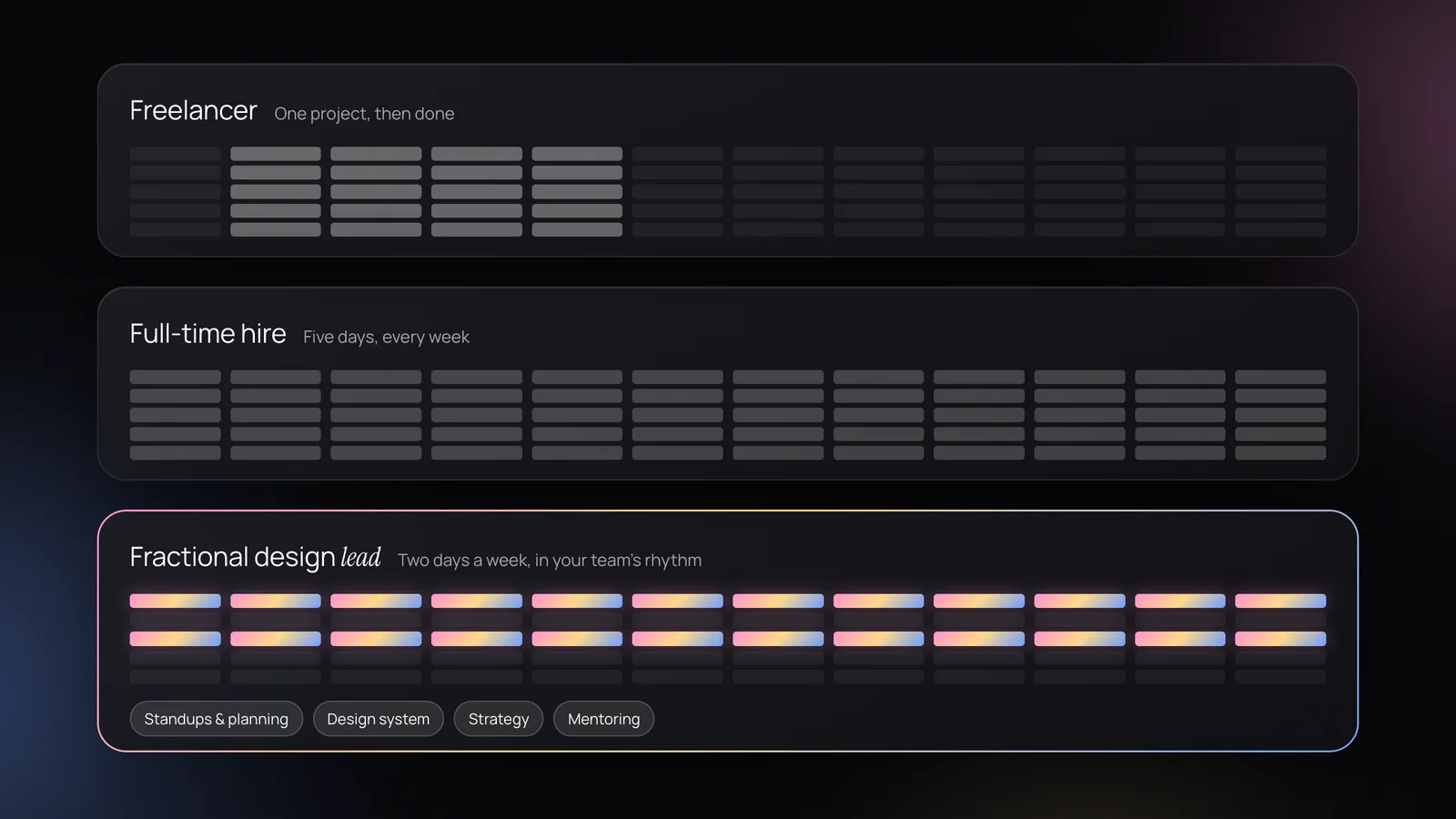
You know your product needs better design. The harder question is what shape that help should take: a freelancer for a project, a full-time designer, or something in between. “Fractional” is the in-between, and it’s become popular for good reason.
Here’s how the three options really differ, beyond the job titles, and how to choose the right one for where your product is now.
What a fractional design lead is
A fractional design lead is a senior designer who works with your team on an ongoing basis for part of the week, usually one to three days, while working with a small number of other companies. The important word is lead. They aren’t there to produce assets on request; they’re there to own design quality.
In practice, that means they:
- Join the team’s rhythm. Standups, planning, design crits and stakeholder reviews, not just async handoffs.
- Set direction. Product and UX strategy, priorities and the trade-offs behind them, not only how screens look.
- Own the system. The design system, consistency across the product and the standards new work is held to.
- Raise the team’s level. Guiding junior designers, helping developers make good design calls and explaining decisions to leadership in business terms.
How it compares with a freelancer
A freelancer is usually hired for a defined piece of work: a new onboarding flow, a landing page, a round of screens. The brief goes in, the designs come out and the engagement ends. That’s exactly right for contained projects, and often the fastest way to get one done.
The difference is ownership. A freelancer owns the deliverable. A fractional lead owns the outcome, across releases. They notice when a new feature undermines an old one, they keep the system coherent as the product grows, and they’re still there when the analytics come back. Seniority varies widely among freelancers; a fractional lead is senior by definition, because the role depends on judgement rather than output.
How it compares with a full-time hire
A full-time designer gives you the most hours and the deepest product knowledge over time. For a team that needs design every day, across several squads, that’s hard to beat.
But a full-time senior hire is a big commitment: a lead-level salary, on-costs, recruitment time and months of onboarding before they’re at full speed. Many startups and growing companies need senior design decisions long before they have forty hours a week of design work, or the budget, to justify that hire. Hiring mid-level instead often means paying for five days of work that still needs someone senior to direct it. We wrote about that trade-off in why a senior part-time designer can beat a full-time mid-level hire.
The three side by side
- Freelancer. Seniority varies. Focused on a task, with little time in team meetings. Project-based, ending on delivery. Best for contained work with a clear brief.
- Fractional design lead. Senior or lead level. Embedded in the team and shaping strategy. Ongoing, usually months to years. Best when you need design leadership and a steady pace, without a full-time hire.
- Full-time hire. Any level. Fully dedicated to one company. Permanent. Best when design is needed daily across several teams, ideally with a lead already in place.
Why teams choose fractional
- Senior judgement at a fraction of the cost. You get lead-level thinking without a lead-level salary, equity and overheads.
- Speed to value. Cross-industry experience means patterns, pitfalls and solutions are already familiar. There’s little ramp-up before the work improves.
- Right-sized commitment. Scale the days up for a launch and back down afterwards, rather than locking in a fixed headcount.
- A fresh perspective that stays. Someone outside the day-to-day politics, but close enough to the product to make decisions that last.
When fractional isn’t the right fit
It isn’t for every team. If you need a single, well-defined deliverable and nothing after it, a project-based engagement is simpler. If design work fills every day across multiple squads, you’ll eventually want full-time designers, and a fractional lead is often the person who helps you hire and onboard them. And if nobody on your side can make product decisions or give timely feedback, no designer, fractional or otherwise, will move as quickly as they could.
How to make a fractional engagement work
- Agree on outcomes. What should be better in a month, and in a quarter? Start there, not with hours.
- Fix the rhythm. Regular days and the same standing meetings each week keep momentum between sessions.
- Give real access. The same channels, tools and data as the product and engineering team.
- Commit for long enough. Three months is a sensible minimum: long enough to understand the product and show results, short enough to review honestly.
That’s exactly how we work with product teams at Studio Ariel. Our fractional design lead engagement runs from four to twenty days a month, with a three-month minimum and a senior designer in your standups and planning. If you’re weighing up your options, book a call and we’ll help you work out which shape of design help fits your team.