Hiring · Design teams
Why a senior part-time designer can beat a full-time hire
Three days a week of senior design often outperforms five days of mid-level: better work, delivered faster, without the hand-holding.
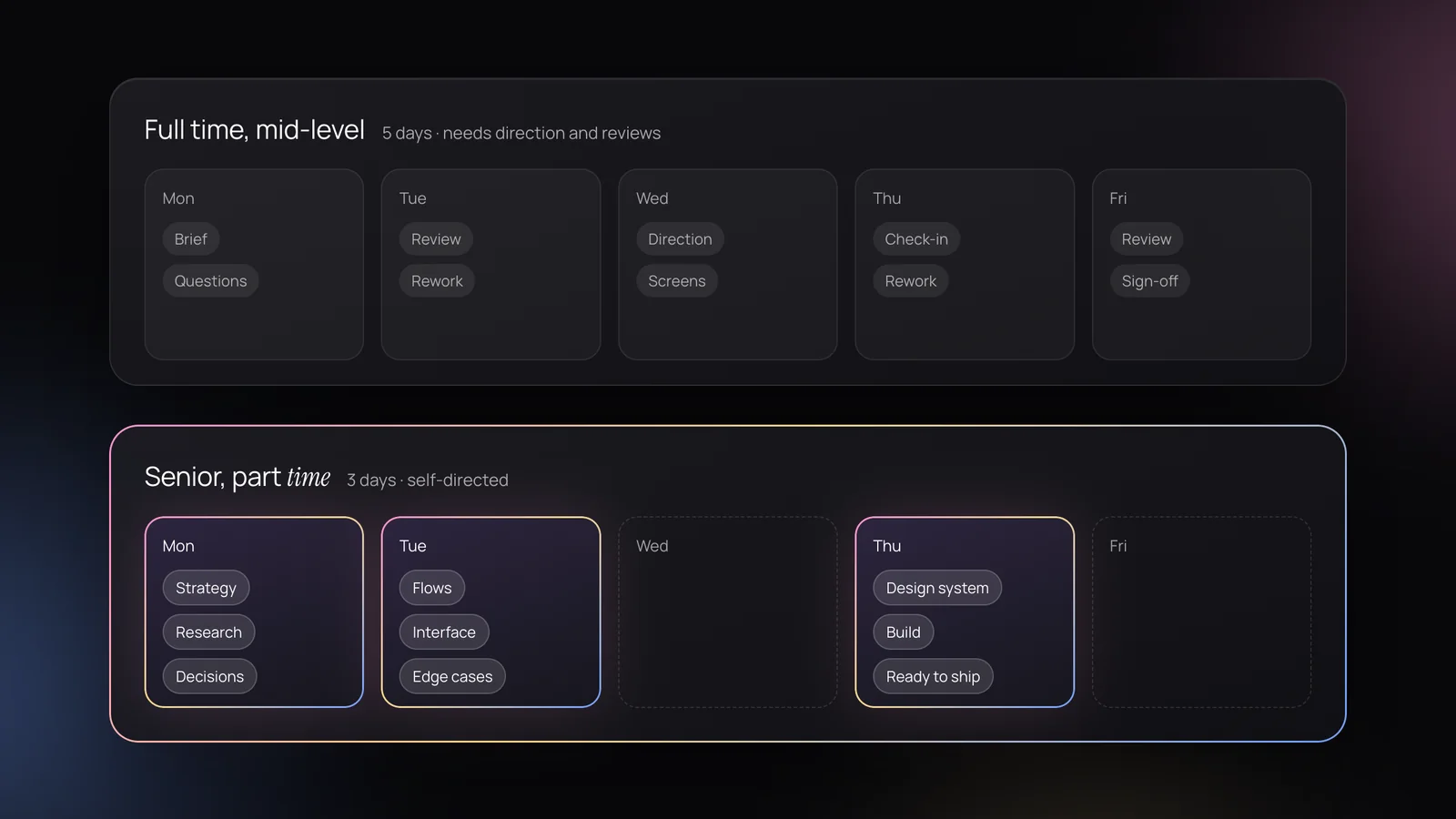
When a team decides it needs design, the default move is to hire: budget for a mid-level salary and wait for someone to join full time. It feels like the committed choice. But for many startups, scale-ups and product teams, a senior designer three days a week will produce better work, sooner, with far less of your time spent managing it.
The difference isn’t the number of days. It’s what happens in them.
Quality: better decisions, not just more screens
The most valuable output of a designer isn’t the volume of screens. It’s the quality of the decisions behind them: what to build, what to leave out, and how to make a complex workflow feel simple.
That’s where seniority shows. An experienced designer has seen dozens of products succeed and struggle, so the work tends to be right the first time:
- Edge cases are designed, not discovered in production. Empty states, errors, permissions and long data are part of the first pass.
- Screens fit a system. New work extends a design system instead of adding one-off patterns that need cleaning up later.
- It’s buildable. Designs account for real data, real constraints and how developers will implement them, so less is lost or reworked in handover.
- Fewer redesigns. Getting the problem right early avoids the expensive loop of building something, then designing it again.
Three days of the right decisions beat five days of good effort in the wrong direction.
Speed: faster to the right answer
Senior speed isn’t about drawing faster. It’s about getting to the right answer in fewer cycles.
- Pattern recognition. Most product problems have been solved somewhere before. Knowing which patterns work, and why, skips weeks of trial and error.
- The right questions, early. A short conversation in week one can save a month of building the wrong thing.
- Range across the work. Strategy, UX, interface, design systems and often front-end or AI-assisted development, without waiting on other specialists.
- Fewer review loops. Work arrives considered and explained, so feedback rounds are shorter and fewer.
In practice, a senior designer working three focused days often moves a product further each week than a mid-level designer working five.
No hand-holding
A mid-level designer is usually a good designer who still needs direction: briefs broken down, regular reviews, help prioritising, and someone to learn from. That’s a healthy part of growing a career, but it needs a design lead to provide it. In many teams, that lead is a founder or product manager who already has a full-time job.
A senior designer is self-directed:
- They turn a business goal into a plan, without needing the problem pre-chewed.
- They work directly with founders, product managers and developers, and manage stakeholder feedback themselves.
- They prioritise against your goals and raise risks before they become expensive.
- They document decisions, so the work keeps moving on the days they’re not in.
The hidden cost of a mid-level hire is often the senior time spent supervising them. With a senior designer, that time comes back to you.
What three days a week looks like
A typical rhythm is two days on the core product work (research, flows and interface), one day on the design system, build support and reviews with developers, and a short weekly check-in with the team. Shared files and written decisions mean nothing stalls in between, and the number of days can flex up for a launch or down in a quieter month.
The cost side
Salary is only the visible part of a permanent hire. In Australia there’s also superannuation (12% on top of salary), leave, equipment and software, recruitment, onboarding and the months before someone is fully productive. A three-day senior arrangement turns that into a predictable cost that matches the work, with no long-term lock-in if your needs change.
When a full-time hire is the right call
Part time isn’t always better. A full-time designer makes more sense when design is needed every day across several squads, when you already have a design lead to mentor and direct them, or when the product is mature and the work is steady iteration within an established system.
Many teams do both: a senior designer sets the direction, the foundations and the design system first, then helps hire and onboard the right full-time people later.
How to make it work
- Agree on outcomes, not hours. Be clear on what success looks like this month and this quarter.
- Give direct access. Put the designer in the same channels as product and engineering.
- Keep a steady rhythm. Fixed days and a weekly check-in keep momentum between them.
- Work in the open. Shared files and documented decisions mean nothing lives in one person’s head.
If you’re weighing up a hire, ask a simple question: do we need more design hours, or better design decisions, made faster, without someone to manage them? If it’s the second, three days of senior design may be the best hire you never make. You can see how we structure a fractional design lead and other ways of working on our get started page.